
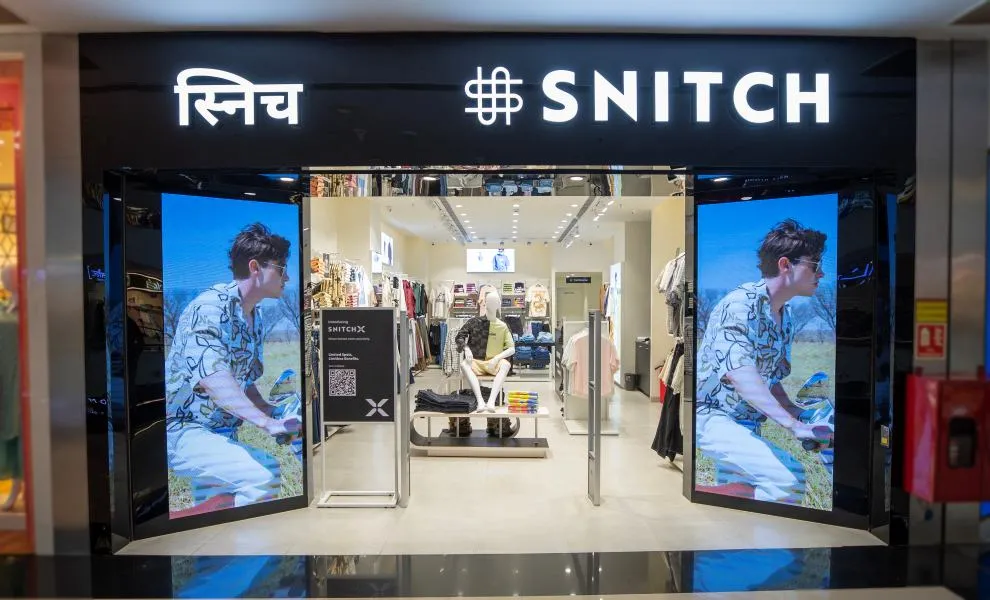
In the last few years, India’s fashion industry has witnessed a major transformation. Consumers are no longer dependent only on traditional fashion brands and large retail chains. A new generation of digital-first fashion brands has emerged, combining social media, influencer marketing, e-commerce, celebrity culture, fast-moving trends, and aggressive brand communication.
One of the most interesting examples of this transformation is SNITCH.
SNITCH has established itself as a recognizable name in the Indian fashion market, particularly among young consumers looking for contemporary men’s fashion. What makes the brand particularly interesting is not just the products it sells, but the way it has built a modern fashion identity around them.
From its visual identity and social media communication to influencer collaborations, retail expansion, website experience, product photography, and performance marketing, SNITCH demonstrates how branding can help a relatively new company compete in a highly crowded market.
This article explores the branding strategy of SNITCH, the psychology behind its communication, its digital-first approach, social media strategy, influencer marketing, offline expansion, customer positioning, and the lessons other businesses can learn from its growth.
Understanding the SNITCH Brand
SNITCH operates in the men’s fashion segment and has positioned itself around modern, trend-driven clothing.
The brand primarily appeals to consumers who want fashionable outfits without necessarily moving into the luxury fashion category. Its communication is designed to make fashion feel aspirational, contemporary, energetic, and accessible.
This positioning is important because the Indian fashion market contains several different consumer groups.
At one end are traditional brands that have built their reputation over decades. At the other end are extremely price-sensitive marketplaces where customers often compare products primarily on price.
SNITCH attempts to occupy an interesting middle ground.
It focuses heavily on:
- Trend-conscious fashion
- Strong visual branding
- Youth-oriented communication
- Digital discovery
- Social media visibility
- Influencer culture
- Celebrity association
- Lifestyle positioning
- Omnichannel shopping
Instead of simply communicating “we sell clothes,” the brand attempts to communicate a lifestyle.
That difference is at the heart of modern branding.
The Importance of Brand Positioning
One of the first things SNITCH appears to understand is that a fashion company cannot depend only on product quality.
A shirt can be copied.
A design can be replicated.
A particular style can be produced by competitors.
But a strong brand identity is much harder to copy.
SNITCH has built its positioning around the idea of contemporary men’s fashion that feels current and socially relevant.
The brand speaks to consumers who are conscious of appearance, trends, social media, lifestyle, and personal presentation.
This is especially relevant for Gen Z and younger millennials.
For these consumers, clothing is not simply functional.
Fashion is part of identity.
A customer does not necessarily purchase a particular shirt only because they need a shirt. They may purchase it because it fits the image they want to project.
This is where branding becomes powerful.
SNITCH’s marketing frequently presents clothing within lifestyle-oriented visual environments rather than treating every product as an isolated catalogue item.
The objective is to help consumers imagine themselves wearing the product.
That is a classic example of aspirational branding.
Building a Distinctive Visual Identity
Fashion is an extremely visual industry.
Before customers read a product description, they often notice:
- Photography
- Models
- Colors
- Typography
- Website layout
- Packaging
- Instagram posts
- Advertisements
- Video content
SNITCH has invested heavily in creating a recognizable visual environment across these touchpoints.
Its branding tends to use modern fashion photography, bold compositions, contemporary styling, and high-energy creative formats.
This consistency helps create familiarity.
A consumer may encounter the brand through Instagram one day, an advertisement another day, a website another day, and an offline store later.
If the visual language remains consistent, every interaction reinforces the same brand memory.
That is one of the fundamental principles of effective branding.
Branding Through Photography
Photography plays a particularly important role in fashion branding.
SNITCH does not merely need to show customers what a shirt looks like.
It needs to communicate how the customer might feel wearing that shirt.
This is why fashion brands spend considerable resources on:
- Models
- Lighting
- Locations
- Styling
- Poses
- Camera angles
- Editing
- Video production
- Art direction
SNITCH’s visual communication often focuses on creating a lifestyle around its clothing.
Instead of saying:
“Here is a black shirt.”
The visual message becomes closer to:
“This is the kind of person you could become or the kind of lifestyle you could participate in by wearing this.”
That subtle shift can significantly influence purchasing decisions.
The Power of Social Media Branding
Social media has become one of the most important branding channels for modern fashion companies.
SNITCH has used platforms such as Instagram to remain constantly visible among its target audience.
Its social media communication typically combines:
- Product promotions
- Fashion inspiration
- Reels
- Influencer content
- Lifestyle photography
- Offers
- New launches
- Seasonal campaigns
- Trend-driven content
The advantage of this approach is frequency.
Traditional advertising might expose consumers to a brand occasionally.
Social media allows a brand to appear in front of consumers repeatedly.
Repeated exposure increases familiarity.
Familiarity can increase trust.
Trust can eventually contribute to purchase decisions.
This is particularly powerful in fashion because the audience is already consuming fashion-related content on social platforms.
SNITCH is therefore not simply advertising where its audience exists.
It is participating in the environment where its audience discovers trends.
Reels as a Branding Tool
Short-form video has fundamentally changed fashion marketing.
A photograph can show a product.
A Reel can show:
- How the product moves
- How it fits
- How it can be styled
- How it looks in different environments
- How an outfit changes with accessories
- How a creator reacts to it
This makes short-form video highly effective for fashion discovery.
SNITCH’s social strategy benefits from this format because clothing naturally lends itself to visual transformation.
For example, a creator can begin with a simple outfit and transition into a complete SNITCH look.
The content becomes entertaining while simultaneously demonstrating the product.
That is much more powerful than a conventional product advertisement.
Influencer Marketing Strategy
Influencer marketing has become a major component of fashion branding.
Consumers increasingly discover products through creators they already follow.
Instead of hearing about a brand from a traditional advertisement, a consumer might see:
“Get ready with me.”
“Three outfits for a date.”
“Best shirts for a party.”
“Weekend outfit ideas.”
“Men’s fashion essentials.”
The brand can naturally become part of that content.
SNITCH’s association with creators and popular personalities helps it borrow attention and credibility from existing audiences.
However, the real value of influencer marketing is not simply reach.
It is contextual relevance.
When a fashion creator wears a particular product, the consumer sees the product in a real styling context.
The influencer effectively becomes a temporary brand ambassador.
Celebrity Branding
Celebrity association is another powerful branding mechanism.
When a fashion brand works with recognizable personalities, it can rapidly increase awareness.
Celebrity marketing can provide three major benefits:
1. Attention
A recognizable personality naturally attracts more attention to a campaign.
2. Aspirational Value
Consumers may associate the celebrity’s lifestyle or appearance with the brand.
3. Social Proof
A popular personality wearing a brand can make that brand appear more culturally relevant.
For a youth-focused fashion company, these psychological effects can be extremely valuable.
However, celebrity marketing works best when it is consistent with the brand’s positioning.
If the celebrity feels disconnected from the audience, the campaign may generate awareness without generating meaningful brand affinity.
Creating a Lifestyle Instead of Selling Products
Perhaps one of the biggest lessons from SNITCH’s branding is the transition from product marketing to lifestyle marketing.
Imagine two advertisements.
Advertisement A:
“Buy our new shirt. ₹X. Available now.”
Advertisement B:
“Your weekend look just got upgraded.”
The first communicates a product.
The second communicates an identity.
Modern fashion brands increasingly prefer the second approach.
Why?
Because products are rational.
Brands are emotional.
Customers can compare shirt prices across multiple websites.
But they cannot easily compare the feeling of belonging to a particular lifestyle.
This is why branding becomes a competitive advantage.
Pricing and Perceived Value
Branding also influences how customers perceive price.
Two companies can sell products with similar manufacturing costs but achieve completely different selling prices because consumers perceive their brands differently.
A strong brand can create perceived value through:
- Presentation
- Photography
- Packaging
- Website experience
- Store design
- Social proof
- Celebrity association
- Influencer content
- Customer reviews
- Brand storytelling
SNITCH’s branding strategy contributes to this perceived value.
The customer is not only paying for fabric.
They are also buying design, convenience, trend relevance, presentation, and the psychological value associated with the brand.
Website as a Branding Channel
For a digital-first fashion company, the website is more than an e-commerce platform.
It is a digital flagship store.
Every component communicates something about the brand.
This includes:
- Homepage design
- Product photography
- Navigation
- Typography
- Product descriptions
- Filters
- Checkout experience
- Offers
- Recommendations
- Mobile responsiveness
- Loading speed
A poorly designed website can damage a strong advertising campaign.
A well-designed website can reinforce the brand promise.
SNITCH’s digital presence is therefore an important part of its branding ecosystem.
The consumer journey often begins with an advertisement or social media post and ends on the website.
Every step needs to feel like the same brand.
Performance Marketing Meets Branding
One interesting aspect of modern D2C brands is that branding and performance marketing are no longer completely separate.
Performance marketing focuses on measurable outcomes such as:
- Clicks
- Leads
- Add-to-carts
- Purchases
- ROAS
- Conversion rate
Branding focuses on:
- Awareness
- Recognition
- Trust
- Perception
- Loyalty
- Emotional connection
SNITCH demonstrates how these approaches can work together.
A Reel can build awareness.
A Meta advertisement can generate traffic.
A retargeting campaign can remind the consumer.
An offer can encourage conversion.
The website can complete the purchase.
A social media follow can keep the customer connected to the brand.
This creates a marketing funnel rather than a single advertisement.
Retargeting and Customer Journey
Most consumers do not purchase the first time they see a fashion advertisement.
They may:
- See an Instagram Reel.
- Visit the website.
- Browse products.
- Leave the website.
- See another advertisement.
- Search for the brand.
- Check reviews.
- Visit Instagram.
- Compare products.
- Finally purchase.
A sophisticated digital brand needs to understand this journey.
Retargeting helps keep the brand visible during the decision-making process.
This is particularly important in fashion because customers often need time to decide between styles, sizes, colors, and alternatives.
Urgency and Promotional Branding
Fashion brands frequently use urgency to accelerate purchasing.
Common psychological triggers include:
- Limited-time offers
- Seasonal sales
- New drops
- Limited collections
- Discounts
- Flash sales
- Festival campaigns
These mechanisms create a reason to purchase now instead of later.
SNITCH’s marketing operates within this broader fashion-industry playbook.
However, the key branding lesson is that promotions should not completely dominate communication.
If every message is a discount, customers can begin to associate the brand with price rather than value.
Strong brands therefore balance promotional content with brand-building content.
New Drops and Trend Culture
Younger consumers are heavily influenced by trends.
Fashion cycles have become significantly faster because social media can make a particular style popular almost overnight.
SNITCH’s branding benefits from this environment.
New collections and trend-oriented products create reasons for consumers to repeatedly revisit the brand.
This can create a “drop culture” where customers become interested in what the brand will release next.
That is a powerful mechanism for increasing repeat engagement.
Instead of:
“I bought something from SNITCH once.”
The relationship can become:
“I want to see what SNITCH launches next.”
That is a much stronger brand relationship.
Offline Stores and Omnichannel Branding
Although digital marketing may be central to SNITCH’s growth story, physical retail remains important.
Offline stores provide something digital channels cannot completely replicate:
Physical experience.
Customers can:
- Touch products
- Feel fabrics
- Try different sizes
- See colors in person
- Experience store ambience
- Interact with staff
For an online-first company expanding offline, the challenge is consistency.
The store should feel like the physical version of the digital brand.
The same personality should exist across:
- Website
- Packaging
- Advertisements
- Stores
- Customer service
This is called omnichannel branding.
When done correctly, customers don’t experience separate marketing channels.
They experience one brand.
Customer Experience as Branding
Branding does not end after purchase.
Customer service, delivery, packaging, returns, exchanges, and post-purchase communication all influence brand perception.
Imagine two scenarios.
In the first, the product is excellent but the customer has difficulty with returns.
In the second, the product is good and the return process is simple.
The second brand may create stronger long-term loyalty.
This demonstrates an important principle:
Every customer interaction is a branding opportunity.
Modern brands therefore need to treat customer experience as part of marketing.
The Role of Packaging
Packaging may appear like a small detail, but it contributes to the overall brand experience.
When customers receive an order, the packaging is often the first physical interaction they have with the company.
Good packaging can create:
- Recognition
- Excitement
- Premium perception
- Shareability
- Memorability
In the age of unboxing videos and social media, packaging can even become user-generated content.
This turns an operational expense into a marketing asset.
Community and Social Proof
A strong fashion brand is not built only by the company.
Customers contribute to the brand.
When people post:
- Outfit pictures
- Reviews
- Unboxing videos
- Styling ideas
- Reels
- Stories
they create social proof.
Potential customers then see real people using the products.
This can reduce uncertainty.
User-generated content is particularly powerful because it often feels more authentic than traditional advertising.
For fashion brands, this creates a feedback loop:
Brand creates products → creators wear them → customers discover them → customers purchase → customers create content → new customers discover the brand.
This loop can significantly increase organic visibility.
Why SNITCH Appeals to Young Consumers
The brand’s appeal can be understood through several psychological factors.
Trend Relevance
Young consumers want clothing that feels current.
Visual Appeal
High-quality imagery creates aspiration.
Social Proof
Influencers and celebrities reinforce credibility.
Convenience
Digital shopping makes discovery and purchasing easier.
Variety
Frequent product launches provide more choices.
Identity
The brand allows consumers to express themselves through fashion.
Together, these factors create a compelling proposition.
Lessons From SNITCH’s Branding Strategy
There are several lessons businesses from other industries can learn from SNITCH.
1. Don’t Sell Only the Product
Sell the transformation.
Instead of selling a gym membership, sell confidence.
Instead of selling a digital marketing course, sell career growth.
Instead of selling furniture, sell a better home experience.
Products are easier to compare.
Outcomes are more emotional.
2. Build a Recognizable Visual Identity
Your audience should be able to recognize your content before reading the company name.
Consistency matters.
Use consistent:
- Fonts
- Colors
- Photography
- Layouts
- Tone
- Video style
3. Make Social Media Part of the Brand
Don’t treat Instagram as a notice board.
Use it to build personality.
Create content people actually want to consume.
4. Use Influencers Strategically
Don’t select influencers only based on follower count.
Consider:
- Audience relevance
- Engagement
- Content quality
- Brand fit
- Trust
- Conversion potential
A creator with 50,000 highly relevant followers may generate more value than a celebrity with millions of passive followers.
5. Combine Branding With Performance Marketing
Do not choose between branding and performance.
Use both.
Branding creates demand.
Performance marketing captures demand.
6. Create Reasons to Return
New launches, collections, content, communities, and campaigns can encourage customers to revisit the brand.
Retention is often more valuable than constantly acquiring completely new customers.
7. Think Omnichannel
Your website, social media, advertising, packaging, customer service, and stores should feel like one ecosystem.
SNITCH’s Biggest Branding Advantage
One of SNITCH’s biggest advantages is its understanding of cultural timing.
The modern Indian consumer is increasingly:
- Digitally connected
- Social-media driven
- Influenced by creators
- Interested in personal style
- Comfortable shopping online
- Exposed to global fashion trends
SNITCH operates directly within this environment.
Rather than depending entirely on traditional retail marketing, the brand has built a marketing system around the way modern consumers discover fashion.
This alignment between consumer behavior and marketing strategy is one of the most important reasons its branding stands out.
Challenges for the Brand
Strong growth also creates challenges.
As fashion becomes increasingly competitive, SNITCH needs to maintain differentiation.
Competition can emerge from:
- Established fashion brands
- Other D2C companies
- Marketplace private labels
- International brands
- Social-commerce sellers
- Celebrity-backed fashion companies
Another challenge is maintaining brand perception while scaling.
As companies grow, they must maintain:
- Product quality
- Customer service
- Brand consistency
- Supply-chain efficiency
- Innovation
- Customer trust
Growth can make these areas more difficult.
The next stage of branding therefore requires more than visibility.
It requires loyalty.
The Future of SNITCH Branding
The future of fashion branding will likely become even more digital, personalized, and community-driven.
Artificial intelligence, personalization, creator commerce, social commerce, virtual experiences, and data-driven recommendations will increasingly influence how consumers discover fashion.
Brands will be able to personalize recommendations based on:
- Browsing behavior
- Previous purchases
- Style preferences
- Location
- Seasonal trends
- Engagement patterns
Short-form video will remain important.
Creator-led commerce will likely become even stronger.
Offline stores will continue to play a role, but their purpose may evolve from simply selling products to creating brand experiences.
For SNITCH, this creates significant opportunities.
The brand can continue building a stronger ecosystem where content, commerce, creators, technology, and physical retail work together.
Final Thoughts
SNITCH is an excellent example of how branding can transform a fashion business in the digital era.
Its success is not simply about selling shirts, trousers, jackets, or other apparel.
The larger story is about creating a recognizable identity around modern fashion.
Its branding strategy combines visual storytelling, social media, influencer marketing, celebrity culture, digital advertising, product launches, e-commerce, customer experience, and offline retail.
The most important lesson is simple:
A product gives a customer a reason to buy.
A brand gives a customer a reason to remember.
In an increasingly crowded market, that distinction matters enormously.
SNITCH has demonstrated how a modern Indian fashion brand can use digital-first marketing and lifestyle-oriented branding to become culturally relevant among younger consumers.
For marketers, entrepreneurs, and emerging businesses, the SNITCH story offers an important case study.
The objective of branding is not merely to make a company look attractive.
It is to create a clear answer to a much bigger question:
“Why should customers choose you when hundreds of alternatives are available?”
The brands that answer that question consistently, visually, emotionally, and strategically are the ones most likely to build long-term value.
And that is ultimately what makes the branding of SNITCH worth studying.