
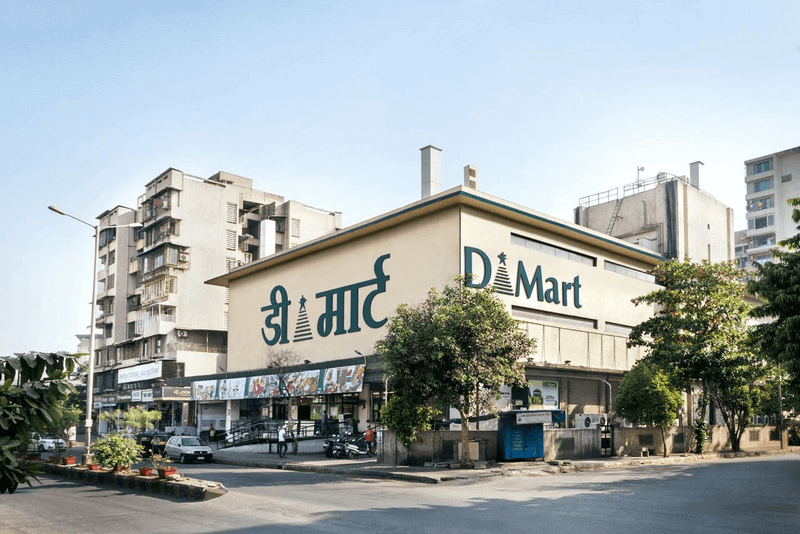
D-Mart is one of the most recognizable retail brands in India. What makes the brand particularly interesting is that its success has not been built primarily around luxury experiences, celebrity endorsements, aggressive advertising, or premium store design. Instead, D-Mart has developed a strong and highly recognizable brand around a simple promise: offering everyday products at attractive prices while maintaining a convenient shopping experience.
The brand has successfully positioned itself as a destination for value-conscious Indian consumers. From groceries and household products to apparel, personal care products, kitchen essentials, and general merchandise, D-Mart has created a retail ecosystem where customers can purchase a wide range of everyday products under one roof.
But D-Mart’s branding goes much deeper than its logo, colors, signage, or advertising.
Its branding is closely connected with its pricing strategy, store locations, product assortment, private labels, customer experience, supply chain, communication style, and business philosophy.
This makes D-Mart an excellent case study for students of branding, marketing, retail management, and digital marketing.
In this article, we will explore the branding strategy of D-Mart in detail, understand its positioning, target audience, visual identity, communication strategy, customer psychology, competitive advantage, and the lessons marketers can learn from the brand.
1. Introduction to D-Mart
D-Mart is a supermarket and hypermarket retail brand associated with Avenue Supermarts Limited.
The brand operates primarily around the concept of providing everyday consumer products at competitive prices.
Unlike many retail brands that try to create a premium shopping environment, D-Mart has traditionally focused heavily on value, affordability, efficiency, and product availability.
This is important from a branding perspective.
Branding is not simply about making a company look attractive.
A brand is the perception that customers develop through repeated interactions with a business.
For D-Mart, that perception can be summarized around ideas such as:
Affordable. Practical. Reliable. Everyday shopping. Value for money.
This positioning has helped D-Mart build strong recognition among Indian consumers.
2. What Is the D-Mart Brand Promise?
A brand promise answers a simple question:
“What should customers expect from this brand?”
D-Mart’s brand promise revolves around value.
Customers generally associate D-Mart with the expectation that they can find commonly purchased products at competitive prices.
This creates a powerful psychological relationship.
Imagine a customer needs to purchase:
- Rice
- Oil
- Soap
- Shampoo
- Detergent
- Biscuits
- Snacks
- Clothes
- Kitchen products
- Household items
Instead of visiting multiple stores, the customer can visit a D-Mart outlet and purchase many of these products together.
The brand therefore becomes associated with convenience + assortment + value.
This is a strong retail positioning strategy.
3. D-Mart’s Core Branding Philosophy
One of the most interesting aspects of D-Mart’s branding is its simplicity.
Many modern brands try to communicate dozens of messages.
D-Mart’s positioning is comparatively straightforward.
The brand does not need to convince customers that shopping there will make them fashionable, luxurious, sophisticated, or aspirational.
Instead, the core message is much more practical:
You can get the products you need at attractive prices.
This creates clarity.
From a marketing perspective, clarity is extremely valuable.
A customer should be able to understand within seconds:
- What does the brand sell?
- Who is it for?
- Why should I choose it?
- What makes it different?
D-Mart has built a relatively clear answer to these questions.
4. D-Mart’s Target Audience
Understanding the target audience is one of the most important parts of branding.
D-Mart’s customer base is broad, but its positioning strongly appeals to value-conscious households and consumers looking for competitive prices on everyday products.
Its audience includes:
Families
Families purchase groceries and household products regularly. A supermarket that combines assortment and value can become part of their routine shopping behavior.
Middle-Income Consumers
Price sensitivity is particularly important for consumers managing household budgets.
D-Mart’s value-oriented positioning resonates strongly with this segment.
Budget-Conscious Shoppers
Consumers who compare prices before purchasing are naturally attracted to retailers that are perceived as offering good value.
Regular Grocery Buyers
D-Mart benefits from repeat purchases because groceries and household essentials are consumed continuously.
Mass-Market Consumers
The brand does not position itself exclusively for a niche premium audience.
Its mass-market orientation allows it to address a broad consumer base.
5. D-Mart’s Positioning Strategy
Positioning means creating a distinct place for a brand in the customer’s mind.
Consider how different retail brands may be perceived.
One brand might stand for:
Premium shopping
Another:
Fashion
Another:
Convenience
Another:
Luxury
D-Mart strongly emphasizes:
Value and affordability.
This is one of its biggest branding strengths.
Instead of competing only on emotional lifestyle positioning, D-Mart has created a strong functional reason to visit its stores.
The customer thinks:
“If I want to buy everyday products and get good value, D-Mart is worth checking.”
That mental association is extremely powerful.
6. Price as a Branding Tool
One of the biggest lessons from D-Mart is that pricing itself can become part of branding.
Most people think branding means:
- Logo
- Colors
- Typography
- Advertising
- Social media
But price can also influence brand perception.
When customers repeatedly experience attractive prices from a retailer, they begin to associate the retailer with affordability.
This creates a form of brand memory.
The customer does not need to see an advertisement every time.
The experience itself communicates the brand.
This is particularly powerful in retail because customers can directly compare prices.
If consumers repeatedly feel that a retailer provides good value, that perception strengthens over time.
7. The Psychology Behind D-Mart’s Branding
D-Mart’s branding works partly because it aligns with everyday consumer psychology.
Indian consumers often compare prices across stores, marketplaces, local shops, and online platforms.
For frequently purchased products, even small price differences can influence purchasing decisions.
D-Mart’s value-oriented positioning therefore connects with several psychological factors.
Perceived Savings
Customers feel they are getting better value.
Smart Shopping
Consumers may feel that shopping at a value-focused retailer represents a financially sensible decision.
Trust
Repeated experiences with products and prices can strengthen confidence.
Convenience
Customers can purchase multiple categories during one visit.
Habit
Once customers establish a regular shopping routine, they may continue returning because changing shopping behavior requires effort.
This combination can create strong customer retention.
8. D-Mart’s Visual Branding
Visual identity is an important part of brand recognition.
D-Mart uses a highly recognizable visual identity built around its brand name, signage, store boards, promotional communication, and consistent retail presence.
The visual language is designed to be:
- Clear
- Highly visible
- Functional
- Easily recognizable
- Suitable for mass-market communication
This is very different from a luxury brand.
Luxury branding often relies on minimalism, subtle colors, spacious layouts, and sophisticated visual storytelling.
D-Mart’s retail branding is much more direct.
The customer needs to immediately recognize the store and understand what it offers.
This reflects an important branding principle:
Visual identity should match positioning.
A value retailer does not necessarily need the same visual language as a luxury fashion house.
9. Store Design as Branding
One of the most important but often overlooked elements of D-Mart branding is the physical store.
The store itself communicates the brand.
When customers enter a D-Mart outlet, they experience:
- Product displays
- Shelves
- Promotional pricing
- Category sections
- Product assortment
- Shopping carts
- Checkout counters
- Store signage
All of these elements contribute to the brand experience.
The store therefore becomes a physical advertisement for the brand.
This is particularly important for retailers because customers interact with the brand physically rather than only through screens.
10. Product Assortment and Branding
A supermarket’s brand is strongly influenced by what products it stocks.
D-Mart’s broad assortment allows customers to purchase multiple categories in one place.
Typical categories include:
- Grocery
- Food products
- Beverages
- Personal care
- Home care
- Kitchen products
- Apparel
- Household items
- General merchandise
This breadth supports the brand’s positioning as an everyday shopping destination.
The more frequently consumers find the products they need, the stronger the store’s relevance becomes.
11. Private Labels and Brand Strategy
Private-label products can play an important role in retail branding.
Instead of depending entirely on external brands, retailers can develop or offer products under their own labels.
Private labels can provide several advantages:
- Product differentiation
- Greater control over pricing
- Potentially better margins
- More control over assortment
- Stronger retailer identity
From a branding perspective, private-label products can gradually strengthen the retailer itself.
Instead of customers associating only with third-party brands, they can begin associating certain products and value perceptions with the retailer.
12. D-Mart and Customer Loyalty
Customer loyalty is not always created through loyalty cards, points, or complicated rewards programs.
Sometimes loyalty comes from repeated positive experiences.
D-Mart’s model demonstrates this principle.
A customer who repeatedly visits a store and feels that:
- Products are available
- Prices are attractive
- Shopping is convenient
- The location is accessible
- The overall experience meets expectations
may naturally develop a habit of returning.
This is behavioral loyalty.
The customer does not necessarily need a special emotional campaign every time.
The shopping routine itself becomes the retention mechanism.
13. D-Mart’s Advertising Philosophy
D-Mart’s branding is interesting because it has historically not relied on advertising in exactly the same way as many consumer brands.
Retail businesses can communicate through several channels:
- Advertising
- Store signage
- Promotions
- Product displays
- Word of mouth
- Customer experience
- Digital platforms
For a value-focused retailer, heavy advertising expenditure is not always the only way to create awareness.
The store network itself creates visibility.
Promotional communication inside and around stores reinforces the value proposition.
This demonstrates a major marketing principle:
A brand’s operations can become its marketing.
14. Word-of-Mouth Marketing
Word of mouth is particularly powerful for retail businesses.
Suppose a customer visits D-Mart and finds that several products are priced competitively.
They may tell family members or friends.
The recommendation could be as simple as:
“D-Mart mein achha rate milta hai.”
That one sentence can communicate the entire positioning.
No billboard is required.
No complicated campaign is required.
The customer becomes the messenger.
This is one reason why a clear and easily explainable brand promise is valuable.
15. D-Mart’s Brand Consistency
Successful brands are consistent.
Consistency does not mean that every advertisement must look identical.
It means the customer should repeatedly experience the same fundamental brand promise.
For D-Mart, the recurring perception revolves around:
- Value
- Everyday products
- Convenience
- Accessibility
- Practical shopping
When branding and customer experience support the same positioning, brand equity grows.
If a company claims to be affordable but customers consistently find it expensive, the brand promise breaks.
D-Mart’s branding is powerful because its operational model supports its marketing positioning.
16. D-Mart vs Premium Retail Branding
To understand D-Mart better, compare it with premium retail brands.
A premium retailer may focus on:
- Luxury interiors
- Premium customer service
- Exclusive products
- High-end ambience
- Lifestyle positioning
- Emotional aspiration
D-Mart’s strategy is different.
Its emphasis is closer to:
- Value
- Product availability
- Practicality
- Everyday shopping
- Price-conscious consumers
Neither approach is automatically better.
The important thing is strategic consistency.
D-Mart has built its identity around a specific consumer need.
17. D-Mart vs Online Retail
The growth of e-commerce has transformed retail.
Consumers can now purchase groceries and household products through online marketplaces and quick-commerce platforms.
This creates a new challenge for physical retailers.
However, physical retail has its own advantages.
Customers can:
- See products physically
- Compare packaging
- Purchase immediately
- Discover products while shopping
- Buy multiple categories in one trip
D-Mart’s physical presence therefore remains an important part of its brand experience.
At the same time, the rise of digital shopping means modern retail brands increasingly need an omnichannel mindset.
18. The Role of Location in D-Mart Branding
Location is a major component of retail strategy.
A brand can have excellent products and prices, but if its stores are inconveniently located, customers may choose another option.
For a supermarket, accessibility can strongly influence shopping frequency.
D-Mart’s physical-store strategy therefore contributes to its overall brand perception.
The closer and more convenient a store is to a consumer’s regular travel pattern, the easier it becomes for that consumer to incorporate the retailer into their routine.
This demonstrates another important branding lesson:
For physical businesses, location is part of the brand experience.
19. D-Mart’s Customer Experience
Customer experience includes every interaction a person has with the brand.
For D-Mart, this can include:
- Seeing the store.
- Entering the outlet.
- Finding products.
- Comparing prices.
- Selecting products.
- Waiting at checkout.
- Completing payment.
- Carrying products home.
- Returning for the next shopping trip.
Each stage affects perception.
This means customer experience cannot be separated from branding.
If the advertising says one thing but the store experience communicates something completely different, the brand becomes inconsistent.
20. D-Mart’s Brand Equity
Brand equity refers to the additional value a company receives because customers recognize and trust its brand.
D-Mart has built significant brand recognition in India’s organized retail sector.
Its brand equity comes from several factors:
Brand Awareness
Consumers recognize the D-Mart name.
Brand Associations
The brand is associated with value-oriented shopping.
Perceived Value
Customers may perceive the retailer as offering competitive prices.
Customer Experience
Repeated shopping experiences reinforce the brand.
Availability
A broad product assortment increases usefulness.
Trust
Consistent experiences can strengthen customer confidence.
Together, these factors create brand equity.
21. D-Mart’s Branding Through Customer Experience Rather Than Luxury
One of the most important lessons from D-Mart is that a strong brand does not necessarily require a premium experience.
A company can build a powerful brand by solving a practical problem extremely well.
For D-Mart, that problem is:
How can consumers purchase everyday products conveniently while getting strong value?
The company has built its branding around answering that question.
This is particularly relevant for entrepreneurs.
Many startups spend enormous amounts of money trying to make their brand look premium before figuring out whether their product actually delivers value.
D-Mart demonstrates the opposite approach.
Build the value proposition first. Then make the brand communicate it clearly.
22. The Role of Trust in D-Mart Branding
Retail involves trust.
Customers need to believe that:
- Products are genuine.
- Prices are reasonable.
- Product quality is acceptable.
- The shopping process is reliable.
- The store will be available when they need it.
Trust is especially important when customers are purchasing products for their families.
Repeated experiences can transform an unknown retailer into a trusted shopping destination.
This is why consistency is such an important part of retail branding.
23. D-Mart’s Brand Personality
If D-Mart were a person, its personality would likely be perceived as:
- Practical
- Value-conscious
- Straightforward
- Reliable
- Family-oriented
- Sensible
- Accessible
This is different from brands that position themselves as:
- Luxurious
- Rebellious
- Trendy
- Exclusive
- Aspirational
Brand personality helps consumers emotionally categorize businesses.
D-Mart’s personality aligns closely with its target audience and value proposition.
24. Why D-Mart’s Branding Works
Several elements work together.
Clear Positioning
The brand is strongly associated with value.
Strong Functional Benefit
Customers have a practical reason to choose it.
Broad Product Range
Multiple shopping needs can be addressed in one place.
Repeat Purchase Category
Groceries and household products create frequent shopping opportunities.
Consistency
The brand experience reinforces its positioning.
Customer Habit
Regular shopping can become routine.
Word of Mouth
Satisfied customers can naturally communicate the value proposition.
Physical Visibility
Stores create strong offline brand presence.
This combination creates a powerful retail brand.
25. What Digital Marketers Can Learn From D-Mart
D-Mart offers several lessons for digital marketers.
Lesson 1: Positioning Comes First
Before creating Instagram posts, running Google Ads, or designing a logo, define what the brand stands for.
Ask:
Why should customers choose you instead of competitors?
Lesson 2: Give Customers a Reason to Remember You
A brand needs a clear association.
D-Mart is strongly connected with value-oriented shopping.
Lesson 3: Don’t Confuse Branding With Design
A beautiful logo cannot save a weak business proposition.
Branding is the combination of:
Strategy + Identity + Communication + Experience.
Lesson 4: Consistency Builds Memory
Customers should repeatedly receive similar signals from the brand.
Lesson 5: Customer Experience Is Marketing
Every customer interaction influences brand perception.
Lesson 6: Value Can Be a Brand
You don’t always need an emotional luxury proposition.
Solving a practical problem extremely well can create powerful brand loyalty.
26. What Small Businesses Can Learn From D-Mart
The D-Mart model is also useful for local businesses.
Imagine a local grocery store wants to compete with larger retailers.
It may not have the same scale.
Instead of copying everything, it can identify its own positioning.
For example:
“Best grocery delivery within 3 km.”
Or:
“Fresh products sourced daily.”
Or:
“Best family grocery store in the neighborhood.”
The lesson is not:
Copy D-Mart.
The lesson is:
Find a clear customer benefit and build the entire business around delivering it.
27. D-Mart Branding in the Age of AI
The retail industry is entering a new phase where AI can influence:
- Customer recommendations
- Demand forecasting
- Inventory management
- Pricing
- Personalization
- Customer service
- Marketing
- Data analysis
For marketers, this means retail branding may become increasingly personalized.
However, the core brand promise remains important.
Technology can improve execution.
It cannot replace a clear brand strategy.
A retailer still needs to answer:
Who are we?
Who do we serve?
Why should customers choose us?
What do we want customers to remember?
These questions remain at the heart of branding.
28. SWOT Analysis of D-Mart’s Branding
Strengths
- Strong brand recognition
- Clear value-oriented positioning
- Broad product assortment
- Strong customer familiarity
- Repeat purchase categories
- Strong offline presence
- Practical brand personality
Weaknesses
- Physical retail depends on store accessibility
- Shopping experience may not appeal equally to premium consumers
- Traditional retail formats can face changing consumer expectations
- Increasing digital competition
Opportunities
- E-commerce
- Digital customer engagement
- Personalization
- Technology-driven retail
- Expansion into new markets
- Omnichannel experiences
- Data-driven marketing
Threats
- E-commerce marketplaces
- Quick-commerce platforms
- Organized retail competitors
- Local retailers
- Changing consumer expectations
- Increasing competition for convenience
This SWOT analysis demonstrates why a strong brand still needs continuous adaptation.
29. The D-Mart Branding Formula
The D-Mart branding strategy can be simplified into a useful framework:
Clear Positioning
↓
Strong Value Proposition
↓
Competitive Pricing
↓
Relevant Product Assortment
↓
Consistent Customer Experience
↓
Repeat Purchases
↓
Customer Trust
↓
Brand Loyalty
This is not a shortcut to building a successful brand.
Rather, it shows how multiple business elements can reinforce each other.
30. Final Conclusion
D-Mart is an excellent example of how branding can be built through more than advertisements, logos, social media posts, or visual identity.
Its brand strength comes from the alignment between positioning, pricing, product assortment, physical stores, customer experience, and consumer expectations.
The central lesson from D-Mart’s branding strategy is simple:
A powerful brand promise must be supported by a powerful customer experience.
If a company claims to offer premium quality, customers should experience premium quality.
If a company claims to be innovative, customers should experience innovation.
If a company claims to offer convenience, the buying process should actually be convenient.
And if a brand positions itself around value, customers need to consistently feel that they are receiving value.
D-Mart’s success demonstrates how powerful this alignment can be.
Its branding is not dependent entirely on flashy communication. Instead, the brand has become associated with a practical consumer benefit that people can experience directly.
For branding students and digital marketers, this is perhaps the biggest lesson:
Branding is not just about what a company says. Branding is about what customers repeatedly experience, remember, and tell other people.
D-Mart has built its identity around a clear proposition: everyday retail with strong value orientation.
That clarity has helped transform a supermarket chain into one of India’s most recognizable retail brands.
For marketers, entrepreneurs, and students, the D-Mart case study reinforces an important principle:
Don’t start by asking, “How should my brand look?”
Start by asking:
“What should my customers remember about my brand—and what can I consistently do to make that memory true?”
That is where real branding begins.