
Branding is often misunderstood as the process of creating a new logo, changing colors, redesigning packaging, or launching a new advertising campaign.
In reality, successful branding is about much more than visual design.
A strong brand needs to evolve with consumers while remaining recognizable enough to preserve the emotional connections it has built over time.
The latest Jif peanut butter branding refresh is an excellent example of this principle.
In August 2026, Jif introduced its first major brand refresh in more than 30 years. Instead of completely replacing its recognizable identity, the brand modernized its existing visual assets, refreshed its packaging photography, updated its typography and repositioned peanut butter as something that can be enjoyed beyond the traditional peanut butter and jelly sandwich.
The strategy is particularly interesting because Jif is not trying to become a completely different brand.
It is trying to become a more relevant version of the same brand.
That distinction is important.
Jif already has extremely strong brand recognition. The challenge is not making consumers recognize Jif.
The challenge is expanding what consumers associate with Jif.
For decades, Jif has been strongly associated with the classic PB&J sandwich. The new branding attempts to expand that association toward snacking, dipping, smoothies, yogurt bowls, crackers, fruit, rice cakes, peanut noodles and other everyday food occasions.
This article explores the new Jif branding, its visual identity, packaging strategy, positioning, campaign strategy, consumer psychology, and the branding lessons businesses can learn from it.
What Is the New Jif Branding?
The new Jif branding is a strategic brand refresh rather than a complete rebrand.
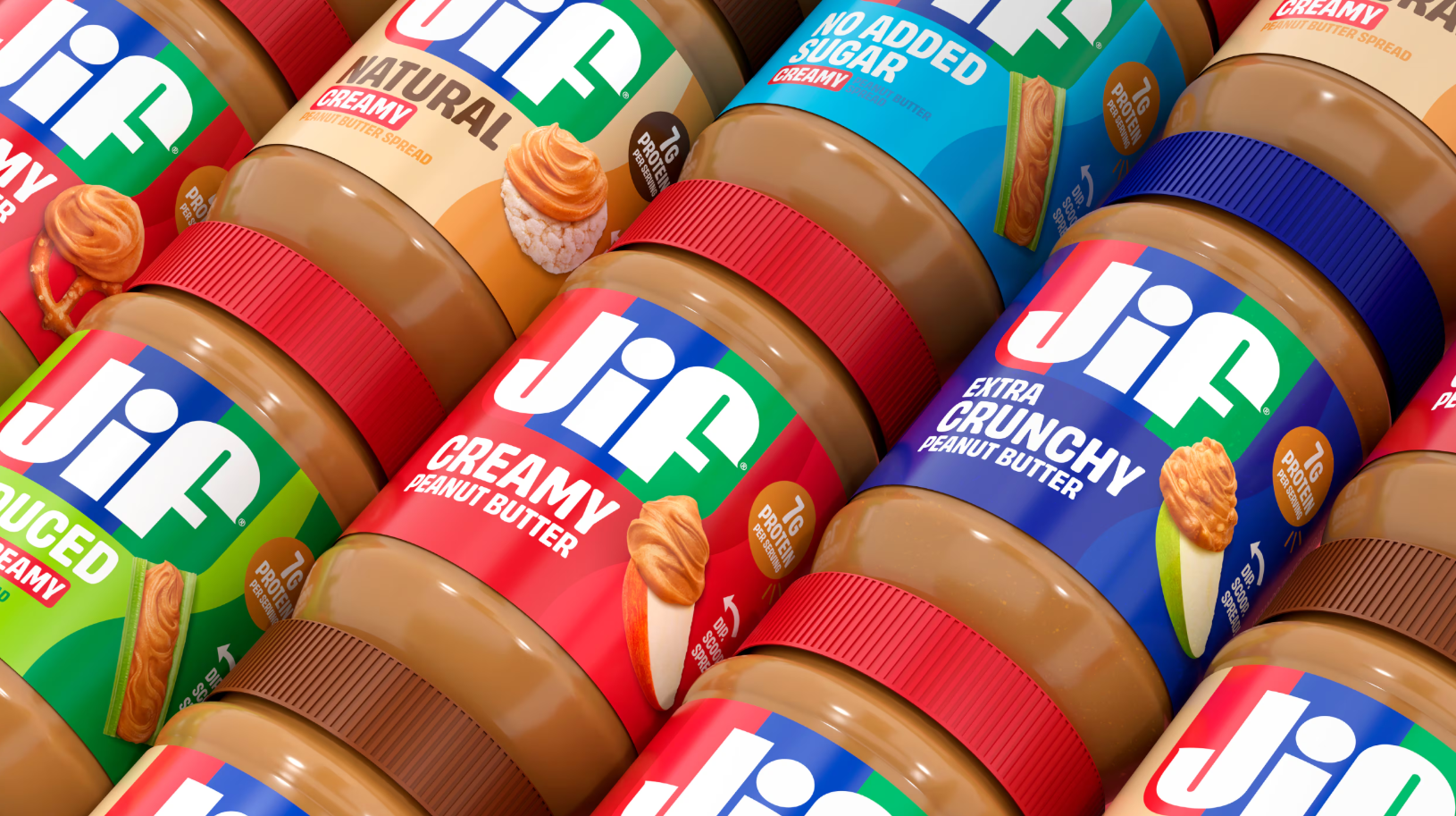
Jif has retained the recognizable elements that consumers associate with the brand while making them cleaner and more contemporary.
The refresh includes:
- An updated Jif logo
- A modernized wordmark
- Removal of the old drop shadow
- Revival of the signature red, blue and green banner
- Updated typography
- New packaging photography
- More prominent snack imagery
- A broader product-use positioning
- New creative communication
- Updated product presentation
- A new campaign built around different ways to enjoy Jif
Jif describes the refresh as its first major design update in more than 30 years. The objective is to preserve the brand’s iconic elements while giving them new energy.
This is an important branding lesson:
You do not always need to destroy an old identity to create a new one.
Sometimes the smartest rebrand is the one that changes less—but changes the right things.
Why Did Jif Refresh Its Branding?
The primary reason behind the refresh is changing consumer behavior.
Jif realized that its product had a much broader potential role in consumers’ lives than simply being one half of a PB&J sandwich.
According to reporting around the launch, Jif appeared in only about 4% of total snacking occasions, while consumers increasingly use peanut butter in different snack and meal combinations.
That creates a significant branding opportunity.
The problem wasn’t necessarily:
“People don’t know Jif.”
The problem was:
“People know Jif, but they may associate it too narrowly with PB&J.”
That distinction changes the entire marketing strategy.
Instead of increasing awareness, Jif needs to increase usage occasions.
The brand therefore wants consumers to think:
Jif = peanut butter for everyday snacking
rather than:
Jif = peanut butter for PB&J sandwiches
That is a positioning expansion.
Jif’s Biggest Branding Challenge
Jif has something that many modern brands would love to have:
decades of recognition.
But brand recognition can sometimes become a limitation.
Consumers may strongly associate a legacy brand with one specific product, occasion, or memory.
For Jif, that association is heavily connected to childhood, lunchboxes, family breakfasts and PB&J sandwiches.
Those associations are valuable.
But they can also make it difficult to become relevant to new consumption habits.
The branding challenge therefore becomes:
How do you modernize the brand without destroying the familiarity that made it successful?
Jif’s answer is restraint.
Instead of abandoning the old identity, the company is evolving it.
The New Jif Logo
The logo is one of the most interesting aspects of the refresh.
Jif has retained its recognizable tri-color visual system while removing the dated drop shadow from the lettering.
The result is cleaner, flatter and more contemporary.
The brand itself describes the updated design as a cleaner and bolder expression that can work strongly across both physical shelves and digital environments.
This is a subtle change.
And that’s exactly why it works.
Why Removing the Drop Shadow Matters
Drop shadows were widely used in older packaging and graphic design because they created depth and visual separation.
But modern digital-first branding often favors:
- Simpler shapes
- Cleaner typography
- Stronger contrast
- Flat visual systems
- Flexible responsive designs
Removing the shadow gives the Jif logo a more contemporary appearance without removing its recognizable structure.
This is an excellent example of evolutionary branding.
The consumer still sees Jif.
But the brand feels fresher.
The Importance of the Jif Tri-Color Identity
One of Jif’s strongest assets is its red, blue and green visual system.
The new branding retains this recognizable identity.
That was a smart decision.
Changing everything at once could have reduced recognition.
Instead, Jif kept a visual asset that consumers already associate with the brand.
Research shared around the campaign indicated that 85% of consumers could recognize the Jif logo through its red, blue and green stripes.
That number demonstrates the value of brand equity.
If consumers already recognize an asset, removing it without a strong strategic reason can be expensive.
Jif chose to leverage that equity.
The New Jif Packaging Strategy
The packaging redesign is arguably more important than the logo update.
Why?
Because packaging is where the brand meets the consumer at the point of purchase.
Jif has introduced new photography and imagery designed to show different ways of consuming peanut butter.
Instead of relying primarily on the classic sandwich association, the packaging highlights food combinations such as:
- Apples
- Celery
- Rice cakes
- Crackers
- Pretzels
- Other snack foods
This makes the packaging itself a form of product education.
The consumer doesn’t just see:
“Peanut butter.”
They see:
“Here are more things I can do with peanut butter.”
Packaging Europe reported that the new packaging puts snack inspiration more prominently into the visual system.
From Product Packaging to Usage Inspiration
This is a major strategic shift.
Traditional packaging communicates:
What is the product?
Modern packaging can communicate:
What can I do with the product?
Jif is moving toward the second approach.
That is powerful because usage inspiration can increase consumption occasions.
If someone sees peanut butter next to an apple on the label, they may subconsciously connect the two.
If they see it alongside crackers, they may think about an afternoon snack.
If they see it in a smoothie or bowl context through advertising, they may consider another use.
The package becomes a mini recipe recommendation.
Jif Is Moving Beyond PB&J
The biggest strategic idea behind the refresh is the move beyond PB&J.
The traditional peanut butter and jelly sandwich remains important.
Jif is not abandoning it.
Instead, the brand wants PB&J to become one use case among many.
That distinction is critical.
The strategy is not:
“Forget PB&J.”
It is:
“PB&J is just the beginning.”
This is a much safer positioning strategy because it expands the brand without attacking its heritage.
The “Every Jif’ing Thing” Campaign
Alongside the visual refresh, Jif launched a new campaign called “Every Jif’ing Thing.”
The campaign demonstrates different ways people can use peanut butter beyond traditional sandwiches.
The campaign creatively transforms Jif’s recognizable identity into different actions and occasions.
The three-letter brandmark becomes a communication device for different uses such as:
- Dip
- Sip
- Mix
- Snack
- Spread
- Add
This is clever because the campaign does not simply say:
“Jif has many uses.”
It visually demonstrates those uses.
Why the Campaign Is Strategically Strong
The campaign connects three things:
Brand recognition + product versatility + cultural relevance
Jif already has recognition.
The campaign adds versatility.
The creative execution makes that versatility entertaining.
This creates a much stronger message than a conventional product advertisement.
Instead of showing another family eating PB&J, Jif shows how the product can fit into different moments throughout the day.
The Use of “O Fortuna”
The campaign uses a remixed version of the famous classical piece “O Fortuna.”
The dramatic soundtrack creates an exaggerated, almost epic treatment for ordinary snacking occasions.
That contrast makes the advertisement memorable.
Something as simple as dipping an apple into peanut butter is treated with the seriousness of an epic event.
This creates humor and attention.
The creative approach demonstrates an important advertising principle:
Make ordinary behavior feel culturally interesting.
Instead of treating peanut butter as boring pantry food, Jif turns it into entertainment.
Jif’s New Brand Positioning
The new positioning can be understood as:
Jif is not just peanut butter for sandwiches. It is an everyday snacking ingredient.
This positioning allows Jif to compete for more occasions.
Morning breakfast.
Midday snack.
Post-workout snack.
Kids’ snack.
Smoothie ingredient.
Protein bowl.
Fruit dip.
Cracker topping.
Cooking ingredient.
Dessert component.
Late-night snack.
The brand becomes more flexible.
From Ingredient Brand to Lifestyle Food Brand
This is another important transformation.
Previously, Jif could be perceived primarily as an ingredient.
The new strategy moves it toward being part of a lifestyle.
Lifestyle branding is about connecting products with moments.
For example:
Morning → breakfast
Afternoon → snack
Workout → protein-focused food
Evening → cooking
Kids → convenient snack
This allows the same product to participate in multiple consumer journeys.
Jif and Convenience
Convenience is another important part of the new strategy.
Jif has introduced squeezable formats and other products designed around easier consumption.
The company has also renamed Jif To Go as Jif Dippers, making the dipping occasion more explicit.
This is more than a naming change.
It makes the consumer behavior part of the product identity.
“Dippers” immediately communicates:
Take it. Dip something. Eat it.
The name explains the use case.
Jif Dippers as a Branding Example
This is a useful lesson in product naming.
A product name should not only sound good.
It can communicate:
- Function
- Usage
- Occasion
- Convenience
- Behavior
“Jif Dippers” is more behavior-oriented than “Jif To Go.”
It tells the consumer what to do with the product.
That makes the product easier to understand.
Jif’s Product Innovation Supports the Rebrand
The branding refresh is not happening independently of product innovation.
Jif has also expanded formats and introduced products such as:
- Jif Peanut Butter & Chocolate Flavored Spread
- Jif Simply Peanut Butter Spread
- Squeezable formats
- Jif Dippers
The company describes these innovations as ways to broaden how consumers can enjoy the brand.
This is important because branding claims must eventually be supported by the product.
You cannot successfully position a brand as convenient if the product experience is inconvenient.
You cannot position a brand around variety if the portfolio doesn’t support variety.
The visual refresh therefore works together with product innovation.
Jif Simply and the Modern Consumer
Jif Simply is another example of portfolio expansion.
The line includes products designed around simpler ingredient positioning, with different formulations and product options.
The 2026 J.M. Smucker presentation highlighted Jif Simply products featuring limited ingredients and protein claims.
This demonstrates how legacy brands can use sub-brands and product extensions to respond to evolving consumer preferences.
The master brand remains familiar.
The product portfolio becomes more diverse.
The Psychology Behind Jif’s Rebrand
The psychology is simple:
Familiarity reduces risk.
Consumers tend to feel more comfortable with brands they already recognize.
That means a radical rebrand can create unnecessary uncertainty.
Jif already owns substantial mental availability.
Its challenge is to add new associations.
Therefore:
Keep old recognition + introduce new associations
is strategically safer than:
Remove old identity + build recognition again
The new Jif refresh follows the first approach.
Why Jif Did Not Completely Change Its Logo
A complete logo redesign might have generated publicity.
But publicity is not necessarily the same as business value.
If Jif suddenly replaced its colors, typography, shape and overall visual identity, consumers might struggle to recognize it.
Instead, Jif maintained its most valuable assets.
This creates continuity.
Consumers can immediately understand:
“It’s still Jif.”
But the cleaner presentation communicates:
“Jif has evolved.”
That is exactly what a mature brand refresh should achieve.
The Role of Typography
Typography is another area where the redesign modernizes the brand.
The cleaner lettering makes the logo easier to reproduce across different environments.
Modern brands need to work across:
- Grocery shelves
- Mobile screens
- Social media
- Websites
- Digital advertisements
- Video
- E-commerce
- Packaging
- Small-format icons
A visual identity designed decades ago may not perform equally well in all of these environments.
Jif’s simplified treatment makes the identity more adaptable.
Jif’s Digital Branding Strategy
Modern packaging is only one part of the brand.
The identity also needs to work digitally.
Jif’s refreshed system is designed to stand out online as well as on shelves.
That matters because consumers now encounter food brands through:
- TikTok
- YouTube
- Online grocery stores
- Recipe websites
- Digital advertisements
- Influencers
- Search
The brand therefore needs to be recognizable outside the supermarket.
Jif and Social Media
The new campaign has been distributed across multiple channels, including broadcast, streaming, online video, Meta, TikTok and Pinterest.
This is a modern integrated marketing approach.
The same brand idea can travel across different platforms.
The execution may change.
But the central message remains:
There are many ways to enjoy Jif.
That consistency strengthens the campaign.
The Role of Creators in the New Jif Branding
Jif’s campaign also uses creator-oriented content.
One example highlighted in campaign coverage involves peanut butter ramen.
This is interesting because creators naturally demonstrate unconventional product uses.
Traditional advertising tells consumers what a product can do.
Creators often show consumers what they can experiment with.
That makes creator marketing particularly useful for a repositioning campaign.
If Jif wants consumers to think beyond PB&J, creators can demonstrate unusual recipes and snack combinations.
Why Creator Marketing Fits Jif
Creators bring three important things:
Discovery
People discover new ideas through creators.
Demonstration
Creators can physically show how products are used.
Social proof
If someone sees another person using peanut butter in a surprising way, the idea can feel more acceptable.
This is especially useful when a brand is trying to create new consumption habits.
Jif’s Branding Strategy Is About Occasions
A very important marketing lesson from the refresh is the shift from product-based thinking to occasion-based thinking.
Product-based thinking asks:
“How do we sell more peanut butter?”
Occasion-based thinking asks:
“Where can peanut butter fit into consumers’ lives?”
The second question creates many more opportunities.
This approach can be applied to almost any category.
A coffee brand can think beyond morning coffee.
A skincare brand can think beyond nighttime routines.
A footwear brand can think beyond sports.
A smartphone brand can think beyond communication.
The goal is to discover more moments where the product can become relevant.
The Jif Rebrand Is a Lesson in Brand Extension
Jif is extending its meaning without abandoning its core.
That is difficult.
A brand extension works when the new association feels credible.
Jif has permission to talk about snacks because peanut butter is already a familiar food product.
The extension therefore feels natural.
If a brand suddenly entered a completely unrelated category, the strategy would be much harder.
What Makes the New Jif Branding Successful?
Several strategic decisions stand out.
It Protects Brand Equity
The recognizable colors and overall identity remain.
It Modernizes Without Overcorrecting
The logo becomes cleaner without becoming unrecognizable.
It Expands Usage
Packaging demonstrates new ways to consume the product.
It Aligns Product and Brand
New formats support convenience and broader usage.
It Uses Humor
The campaign makes a familiar product entertaining.
It Uses Creators
Creators help demonstrate unconventional uses.
It Works Across Channels
The campaign is designed for both traditional and digital media.
It Targets New Occasions
The brand wants to become part of more moments throughout the day.
What Businesses Can Learn From the Jif Rebrand
The Jif refresh provides several important lessons for marketers.
Lesson 1: Don’t Rebrand Just for the Sake of Rebranding
A new logo does not automatically solve a business problem.
First identify the problem.
Jif’s challenge was not lack of recognition.
Its challenge was limited association with consumption occasions.
The rebrand therefore supports a positioning change.
Lesson 2: Protect Your Strongest Brand Assets
If consumers already recognize something, don’t remove it without a strategic reason.
Jif retained its tri-color identity.
That preserves recognition while allowing modernization.
Lesson 3: Modernization Can Be Subtle
You do not need an extreme visual transformation.
Sometimes removing unnecessary visual elements is enough.
Jif’s removal of the drop shadow demonstrates this perfectly.
Lesson 4: Packaging Can Educate
Your packaging can tell consumers how to use your product.
Jif’s new food imagery is effectively a collection of consumption suggestions.
Lesson 5: Expand Usage, Not Just Awareness
If a brand is already well known, increasing awareness may not be the biggest opportunity.
Increasing frequency or occasions can be more valuable.
Lesson 6: Brand Strategy and Product Strategy Must Match
Jif’s broader positioning is supported by new formats and products.
This creates consistency between what the brand says and what the consumer experiences.
Lesson 7: Use Creators to Demonstrate New Behaviors
When you want consumers to use your product differently, demonstration can be more powerful than explanation.
Lesson 8: Heritage Can Be an Advantage
Older brands sometimes believe they need to look completely new to attract younger consumers.
Jif demonstrates another approach.
Heritage can become an asset when it is modernized rather than hidden.
Why This Is a Smart Rebrand for a Legacy Brand
Legacy brands face a unique problem.
They need to appeal to new generations without alienating existing customers.
A radical redesign can generate attention.
But it can also create backlash.
A restrained redesign reduces this risk.
Jif’s refresh is therefore an example of strategic continuity.
The brand essentially says:
“You already know us. Now discover more about us.”
That is a powerful message.
The Future of Jif Branding
The new identity is likely to support Jif’s broader strategy around everyday snacking.
As the packaging transition begins in October 2026 and continues through the fall and early winter, consumers will gradually see the refreshed identity appear across products.
The real test will not simply be whether people like the new logo.
The bigger question is whether consumers begin using Jif in more situations.
If the brand can move from:
PB&J → multiple snacking occasions
then the rebrand will have accomplished something much more valuable than visual modernization.
It will have changed consumer behavior.
Jif Branding Case Study: Before vs After
| Branding Element | Earlier Jif | New Jif |
|---|---|---|
| Logo | Familiar tri-color identity with shadow | Cleaner tri-color identity |
| Positioning | Strong PB&J association | Broader snacking relevance |
| Packaging | Traditional product presentation | Usage-focused snack imagery |
| Consumption | Sandwich-centric | Multiple snack occasions |
| Product formats | Traditional jars and formats | Expanded convenience-oriented formats |
| Jif To Go | Portability-focused name | Jif Dippers |
| Communication | Peanut butter product | Peanut butter possibilities |
| Visual style | Legacy appearance | Cleaner, bolder appearance |
| Campaign focus | Traditional uses | “Every Jif’ing Thing” |
| Consumer message | Peanut butter for sandwiches | Peanut butter for everyday moments |
Frequently Asked Questions About the New Jif Branding
When did Jif change its branding?
Jif announced its new brand refresh on August 10, 2026. It is the company’s first major brand refresh in more than 30 years.
What changed in the Jif logo?
The refreshed logo retains Jif’s recognizable tri-color banner but removes the older drop shadow and uses a cleaner, bolder treatment.
Did Jif change its peanut butter recipe?
No. Jif says the product’s iconic taste remains unchanged despite the branding and packaging update.
Why did Jif rebrand?
Jif wanted to modernize its identity and broaden the brand beyond its traditional association with peanut butter and jelly sandwiches toward everyday snacking occasions.
What is the new Jif campaign called?
The campaign is called “Every Jif’ing Thing.” It demonstrates different ways consumers can use Jif beyond traditional sandwiches.
What happened to Jif To Go?
Jif To Go is being renamed Jif Dippers to more clearly communicate its dipping and snacking use case.
When will the new Jif packaging appear in stores?
Jif says products featuring the refreshed packaging begin shipping in October 2026, with the new look transitioning onto shelves in waves through fall and early winter.
Is the Jif rebrand a complete redesign?
No. It is better described as a major brand refresh. Jif retained core elements such as its recognizable tri-color identity while modernizing the logo, typography, photography and packaging.
Final Thoughts
The new Jif peanut butter branding is a fascinating example of how a legacy brand can evolve without abandoning its identity.
Jif did not need to convince consumers that it exists.
It needed to convince them that it can be relevant in more moments.
That is why the most important part of the 2026 refresh is not the logo.
It is the change in meaning.
The brand is moving from:
“Jif is peanut butter for PB&J.”
toward:
“Jif is peanut butter for everyday snacking.”
The logo modernization supports that idea.
The packaging supports it.
The new products support it.
The Jif Dippers naming supports it.
The creator content supports it.
And the “Every Jif’ing Thing” campaign makes the idea entertaining.
This is what makes the rebrand strategically interesting.
It is not simply a cosmetic redesign.
It is a repositioning supported by visual identity, packaging, product innovation, advertising and consumer behavior.
For marketers, perhaps the biggest lesson is this:
A successful rebrand does not always mean becoming a new brand. Sometimes it means helping consumers see more of the brand they already know.
Jif’s 2026 refresh shows that legacy can be a competitive advantage when it is combined with relevance, restraint and a clear understanding of how consumer behavior is changing.